
Complex domain • human-ai trust • risk intelligence
CCF
Designing trust into AI-assisted lending flows.
I led design for an internal Capital Call Facility (CCF) platform - translating a dense lending domain into a more transparent workflow for managing borrowing bases, monitoring deal risk, and supporting lending decisions.
Role
Design Lead
Timeline
Apr 2026 - Present
Status
UAT • In Progress
01 • Case at a glance
I translated a dense lending domain into an AI-assisted workflow that makes risk visible, decisions accountable, and complex work easier to act on.
Business Context
Replace a $12K/month vendor platform
Design Challenge
Translate a complex lending domain
My approach
Prototype behavior, not just screens
02 • translating domain complexity
From an 80+ page manual to a product the team could interact with.
An 80+ page manual grounded me in an unfamiliar lending domain. I used AI across synthesis, workflow modeling, functional prototyping, QA, and documentation - compressing the path from domain learning to testable product behavior and enabling earlier feedback from stakeholders and engineering.
Domain manual
Lending context +unfamiliar concepts
product logic
Entities, relationships + workflow architecture
functional behavior
interactive screens built directly in Windsurf
Shared decisions
Earlier feedback from stakeholders + engineers
03 • defining the human-ai boundary
Define the boundary before designing the automation.
I partnered with business stakeholders to identify where AI could accelerate repetitive work and where explicit human review had to remain.
humans remain accountable for
Prioritizing and resolving what requires attention
Reviewing ambiguity and approving the final match
Interpreting risk across borrowing bases and related entities
04 • Selected Product decisions
3 decisions made AI-assisted lending easier to act on and safer to trust.
Decision 01 • Centralized action center
Start with what needs attention
Design Response: Centralize actionable exceptions
I designed a centralized Action Center that turns fragmented exceptions into one prioritized review queue.

Decision 02 • Human-Ai trust
Expose uncertainty instead of hiding it
Design Response: Keep uncertainty visible at the point of review
Confidence level and supporting evidence help analysts determine when to accept, review, or question an AI suggestion.

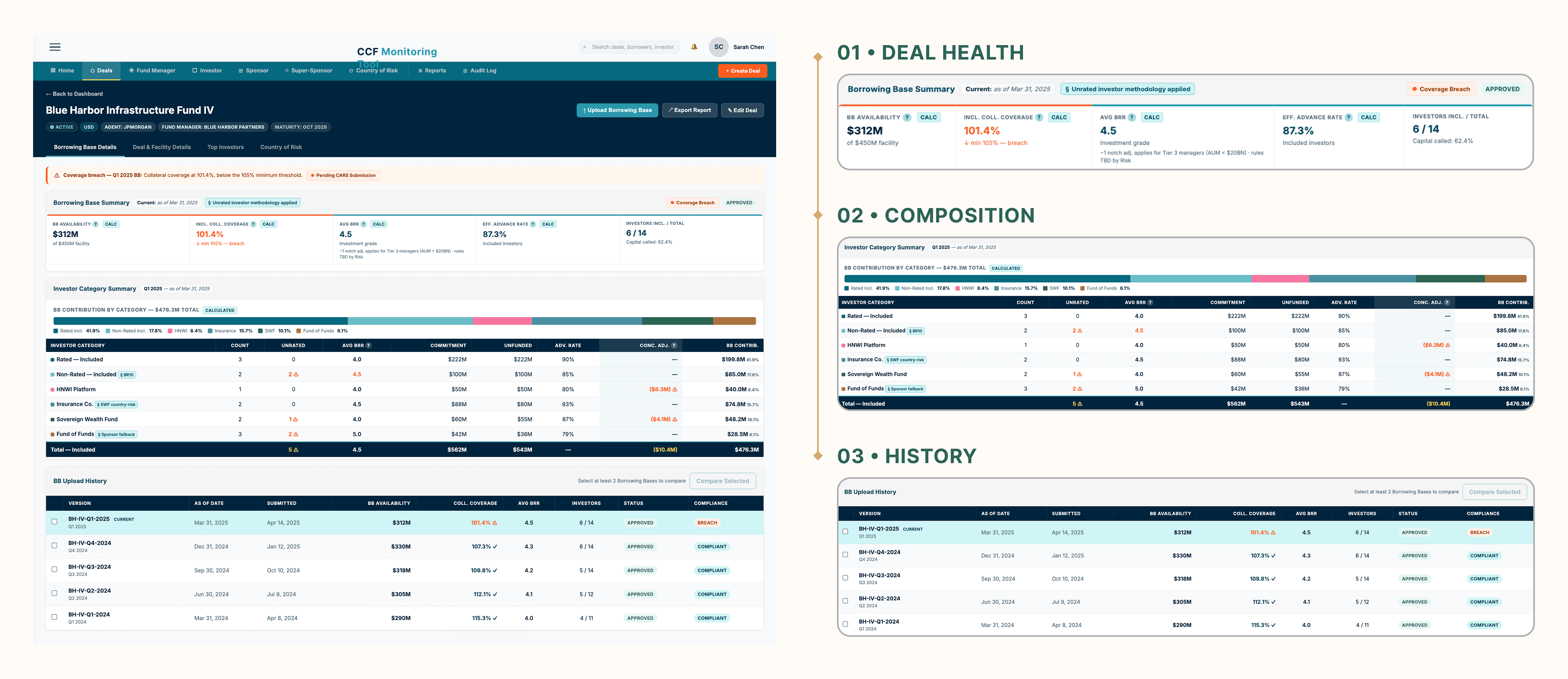
Decision 03 • Connected deal context
Explore deeper without losing context
Design Response: Organize information around the deal, not the page
I reframed the Deal Details page as a connected system view, bringing the borrowing base and related entities into one continuous information structure.
05 • Early Signals
Early value is emerging through consolidation, cost opportunity, and stakeholder confidence.
Outcome measurement is still in progress as the product moves through stakeholder review.
Vendor-cost opportunity
$12K/month
Existing external subscription.
1 Connected Platform
Deal creation, borrowing base management, monitoring, and reporting.
Positive Stakeholder Response
Feedback highlighted design turnaround and domain comprehension.
06 • Reflection
The differentiator was not using AI.
It was deciding where AI should stop.
CCF strengthened my ability to design AI-assisted enterprise workflows where confidence, accountability, and domain context matter as much as speed. It also changed how I work with engineering: functional prototypes made product behavior concrete earlier, while keeping product judgment explicit rather than outsourcing it to the tools.
© 2026 Steph Lee